
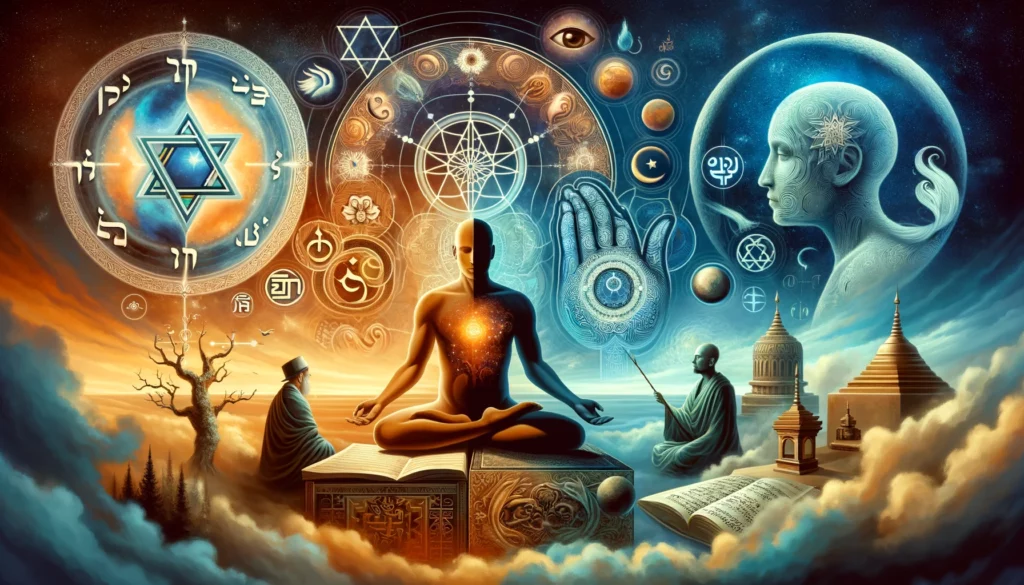
Human existence encompasses more than the physical realm. Many world religions acknowledge the presence of non-physical dimensions within human beings, such as the soul, higher consciousness, and spiritual realms.
These metaphysical aspects of human existence are at the core of many key religious and existential questions and remind us that we are more than just our physical bodies.
More Than a Body, Beyond Flesh and Bones
There is more to reality than can be perceived by our organs of perception. The spiritual path in all religions consists of making efforts to see reality as it is by overcoming the limitations of our cognitive self through many zetetic practices.
The Spiritual Path and Higher Consciousness
The Abrahamic religions of Judaism, Christianity, and Islam teach that the human being is composed of both a physical body and a soul that persists beyond physical death. Hindus believe in a different kind of eternal soul, or “atman,” which is interconnected with the universal soul, or “Brahman.”
What Is the Soul in Religion?
The concept of the soul is absent in Buddhism, which instead teaches the path to transcending the ego and attachments, ultimately attaining enlightenment or nirvana.
Buddhism – Transcending the Physical Self“My present attainment of Nirvana is like being rid of a malignant sickness. The body is a false name, drowning in the great ocean of birth, sickness, old age and death. How can one who is wise not be happy when he gets rid of it?”
–The Buddha
Hinduism – The Eternal Atman Beyond the Body“The soul is not the body. The soul is the immortal essence that inhabits the body. It is the witness of the body’s experiences, but it is not itself an experience.”
–The Bhagavad Gita, Hindu scripture
Christianity“For while bodily training is of some value, godliness is of value in every way, as it holds promise for the present life and also for the life to come.”
–The New Testament (1 Timothy 4:8), Christian scripture
Islam“And He originated the creation of humankind from clay […] then He fashioned them and had a spirit of His Own creation breathed into them.”
–The Qur’an (32:7-9), Islamic scripture
Judaism“The body is a gift from God. We should take care of our bodies and treat them with respect. However, we should also remember that we are more than our bodies. We have a soul that is immortal and that will survive the death of the body.”
–The Talmud, Jewish theological text
Baha’i“From the very birth of a human being the soul progresses, the intellect grows and knowledge increases. When the body dies the soul lives on. All the differing degrees of created physical beings are limited, but the soul is limitless!”
–‘Abdu’l-Bahá, Baha’i prophet
Jainism“A living body is not merely an integration of limbs and flesh but it is the abode of the soul which potentially has perfect perception (Anant-darshana), perfect knowledge (Anant-jnana), perfect power (Anant-virya), and perfect bliss (Anant-sukha).”
–Mahavira, founding Jain prophet
Taoism“My limbs are without feeling and my mind is without light. I have ignored my body and cast aside my wisdom. Thus I am united with the Tao. This is what sitting right down and forgetting is.”
–The Book of Chuang Tzu, Taoist text