


A river, a snake, a door you could not open. Some dreams leave an image with us long after waking, along with a question: What did that mean?
Wisdom traditions give familiar images surprising stories. A snake can concern livelihood. A mountain can become a pillow. A tree can represent a king whose power needs humility.
The eighteen entries below explore particular dream interpretations, sacred dream narratives, and wider religious symbolism. Those connections differ: a teaching about a sacred bridge does not automatically explain a bridge in someone's dream. Each image gains meaning through its story, the people involved, and the world they inhabit.
At UEF, we are often asked about these images. Our religious-literacy work explores what such stories mean within traditions and what they make recognizable in one another. This belongs to our wider focus on loving, learning, and playing as life's ultimate ends.
18 dream symbols and the stories behind them
1. Water
A flowing spring and a muddy pool tell different stories. In Sahih al-Bukhari 7018, Umm al-Ala dreams of a spring for the deceased Uthman ibn Mazun; Muhammad interprets it as the continuing reward of his good deeds. The ninth dream in the Buddhist Mahasupina Jataka shows a pool muddy at its center and clear at its edges: people flee oppressive rulers for the kingdom's borders.
2. Snakes
A dreamed snake can point toward livelihood. The Talmud's Berakhot 57a:20 gives that association while preserving disagreement about killing the snake. Greco-Roman interpreter Artemidorus associates serpents with kingship, time, guarded wealth, and several gods. He also gives the same serpent dream different readings according to the dreamer's circumstances.
3. Flying
Flight toward heaven could mean involuntary relocation to Italy in Artemidorus's Roman world, or an enslaved person's transfer to the imperial household. This historically specific reading puts social life into an impossible journey. The Daoist Zhuangzi, chapter 6, takes another direction: dreaming of being a soaring bird or diving fish raises questions about identity and whether the speakers are awake.
4. Falling
Falling into a pit appears in Brihadaranyaka Upanishad 4.3.20, among terrors formed from fears experienced while awake. The passage belongs to an inquiry into the Self and dreaming.
5. Death
A skull speaks in a dream in Zhuangzi, chapter 18, challenging the living person's assumptions about death. In Chandogya Upanishad 8.10.2, apparent killing and distress in dreams lead Indra to question whether the dream-self is the fearless Self he seeks. Both stories investigate existence, through different philosophical concerns.
6. Light
The dreamer illuminates a world by the self's own light in Brihadaranyaka Upanishad 4.3.9. The passage asks how a dream world is experienced. Qur'an 24:35 uses a lamp, glass, and luminous oil to speak of divine light and guidance. That second passage is a sacred parable, offering wider symbolism rather than an interpretation of a dreamed light.
7. Fire
A burning bed receives an unfavorable domestic reading in the Egyptian Chester Beatty dream manual, connected with driving away a wife. The biblical burning bush marks Moses' encounter with the divine on holy ground. One is a dream reading; the other a waking sacred encounter. UEF's fire-symbolism lesson explores the image's wider religious settings.
Enjoying this article?
Get UEF Insights. Writing on loving, learning, and playing, with insights from wisdom traditions and modern science delivered to your inbox.
8. Bridges
The one Self is called a bridge to immortality in Mundaka Upanishad 2.2.5. Zoroastrian accounts of the Chinwad bridge connect passage between this world and the next with judgment of one's deeds. These are broader sacred images of crossing, not readings of an ordinary dream bridge. A dreamed crossing still has its own destination, companions, and difficulties.
9. Being chased
Goats pursue panthers and wolves flee in the sixteenth dream of the Mahasupina Jataka. The reversal depicts abuses of power, including worthy monastics driven into hiding. Brihadaranyaka Upanishad 4.3.20 names an elephant pursuing the dreamer among fears recreated in sleep. One chase tells a social story; the other enters an inquiry into dreamed fear.
10. Doors
Dreams pass through gates of horn or ivory in Penelope's account in the Odyssey, book 19, distinguishing fulfilled dreams from deceptive ones. After his stairway dream in Genesis 28, Jacob calls his stopping place a gateway to heaven. Penelope offers a literary metaphor; Jacob responds while awake. These related gate images leave an ordinary dreamed door's meaning open.
11. Trees
An immense tree shelters creatures and provides food in Nebuchadnezzar's dream in Daniel 4. Daniel identifies it with the king and his rule; its cutting down challenges his pride. In wider Hindu symbolism, Bhagavad Gita 15.1 pictures existence as a tree rooted above and branching below. UEF's cosmic-tree lesson develops that wider context.
12. Animals
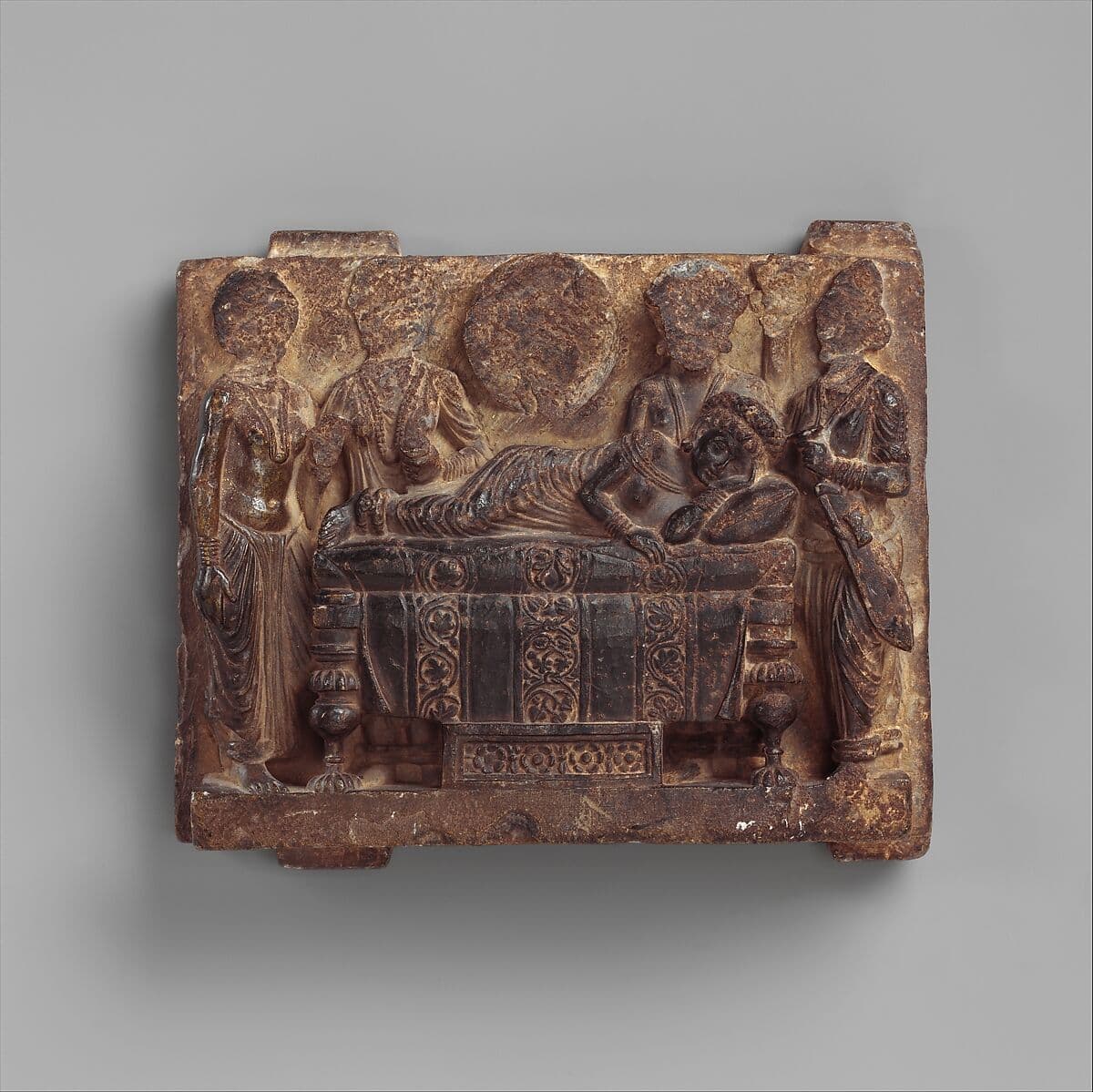
A six-tusked elephant enters Queen Maya's womb in the Buddhist dream story associated with the Met's Dream of Queen Maya relief, marking the Buddha's final rebirth. An Egyptian dream book gives looking after monkeys an unfavorable reading connected with change.
13. Babies
Artemidorus gives dreaming of one's own infants an unfavorable reading because of the cares and demands of raising them, in a passage reproduced in Harvard scholarship. In Matthew 2, Joseph dreams of an angel who directs him to protect Jesus and his mother. That story concerns responsibility for a child; the dreamed figure is the messenger.
14. Birds
Four differently colored birds become white at the bodhisatta's feet in the Buddhist Supina Sutta. The text relates them to people from four castes entering Buddhist monastic life and attaining release through his teaching. Rabbinic dream discussion in Berakhot 56b draws on scriptural associations of protection, peace, and wandering from home.
15. Mountains
The Himalayas become a pillow in the first great dream of the Supina Sutta. The earth is the future Buddha's bed; the whole scene anticipates his awakening within the narrative. The Talmud's dreamed mountains recall both a messenger bringing peace and a landscape drawing lament. A mountain's role can be support, good news, or sorrow.
16. Blood
Leviticus 17 closely identifies a creature's blood with its life. In a passage about sacrifice, Qur'an 22:37 says that meat and blood do not reach God, while the offering person's piety does. These teachings provide cultural background; neither interprets blood in an individual's dream.
17. Angels
The message gives the encounter its meaning. In Matthew 2, an angel directs Joseph to protect the child and his mother, then later guides their return. Sahih al-Bukhari 1386 presents Gabriel and Michael guiding Muhammad through a dream and explaining its moral scenes. These particular accounts join guidance with responsibility and understanding.

Love • Learn • Play
The formula for a meaningful life.
18. Numbers
Seven measures years of abundance and famine in Genesis 41: Joseph interprets Pharaoh's cattle and ears of grain, leading to preparation. In the Qur'an's Yusuf narrative, interpretation leads to conserving harvests for difficult years. A number in another dream may instead evoke a remembered date, family connection, or familiar sacred story.
What a symbol list leaves open
A dream can draw on the dreamer's history. In a 2017 study by Raphael Vallat and colleagues, forty frequent dream recallers recorded dreams and identified waking-life sources over seven days. Most reports had a source the dreamer recognized, including recent events, ordinary experiences, and older memories. Those connections were identified by participants themselves; the selected sample and short observation period limit generalization. The finding supports attention to personal associations, without validating a fixed spiritual dream dictionary.
Shared images can also carry intensely personal meanings. Studying religious devotees in Sri Lanka, anthropologist Gananath Obeyesekere described “personal symbols”: cultural images that also hold individual experience. His ethnographic and psychoanalytic interpretation concerns how private meaning and public symbolism meet. Applied to dreams, that distinction helps explain why a tree might recall both a sacred story and a particular gathering place, without meaning the same thing to everyone.
In UEF's conversation with philosopher Matthew Nini, “night thinking” describes thought expressed through poetry, music, religion, and myth. An image can remain fruitful while several readings stay possible.
What dreaming can ask about the Self
The Māṇḍūkya Upaniṣad examines the experiencer as well as the experience. It distinguishes waking attention to external objects, dreaming attention to internal objects, and dreamless deep sleep. Verse 7 points toward turīya, the “fourth”: in the Advaita reading, the nondual Self beyond these changing descriptions, rather than another ordinary sleep stage.
Gauḍapāda's commentary compares dreaming and waking, asking how experienced objects acquire reality for us. Kārikā II.9-10 develops that comparison: a dream world can appear real while we inhabit it. This is philosophical inquiry into experience and reality.
The lives behind the images
The tree in Daniel represents a ruler whose pride needs confronting. The Jataka's muddy pool depicts a community scattered by oppression. The shared Joseph/Yusuf harvest story turns resources toward preparation for scarcity. These stories bring power, responsibility, and other people's lives into view while retaining their own religious meanings.
UEF's contemporary reading asks a related question about waking life: what are power, resources, and achievement for? We understand loving, learning, and playing as our deepest longings and ultimate ends, worth engaging throughout what we do. Resources matter through the lives they make possible: time to care for someone, freedom to discover, room to create and enjoy together.
Our work on false narratives examines misleading stories of status, rivalry, and separateness. “My job is who I am” reduces a life to a role; “another person's success makes me smaller” obscures our interdependence. When useful means such as money or achievement displace the ends they serve, we call that means-ends inversion. The harvest stories make the distinction concrete: stored grain serves a community's future.
Religious literacy helps us understand what another person holds dear in a dream or story. Its imagery may be unfamiliar while its care, wonder, or delight becomes recognizable. Understanding the tradition makes the person more visible, including where their beliefs differ from ours.
Three questions people bring to dreams
What if I dream about someone who has died? The encounter may feel like remembrance, reunion, or sacred presence. Its significance involves the relationship, the dream's events, and the dreamer's beliefs about death.
Why does the same dream return? Repetition alone supplies no single spiritual explanation. The significance a person finds in a recurring image may change with their circumstances.
Can dreams predict the future? Some sacred narratives portray particular dreams as anticipations of events. Neither those stories nor the memory study establish that an image in a reader's dream forecasts an event.
Explore UEF's Spiritual Significance of Dreams lesson for more sacred narratives and philosophical questions. Continue with Radical Recognition: The Art of Truly Seeing, on encountering people beyond roles and achievements. Subscribe free to UEF Insights for further writing on loving, learning, playing, and living together.