
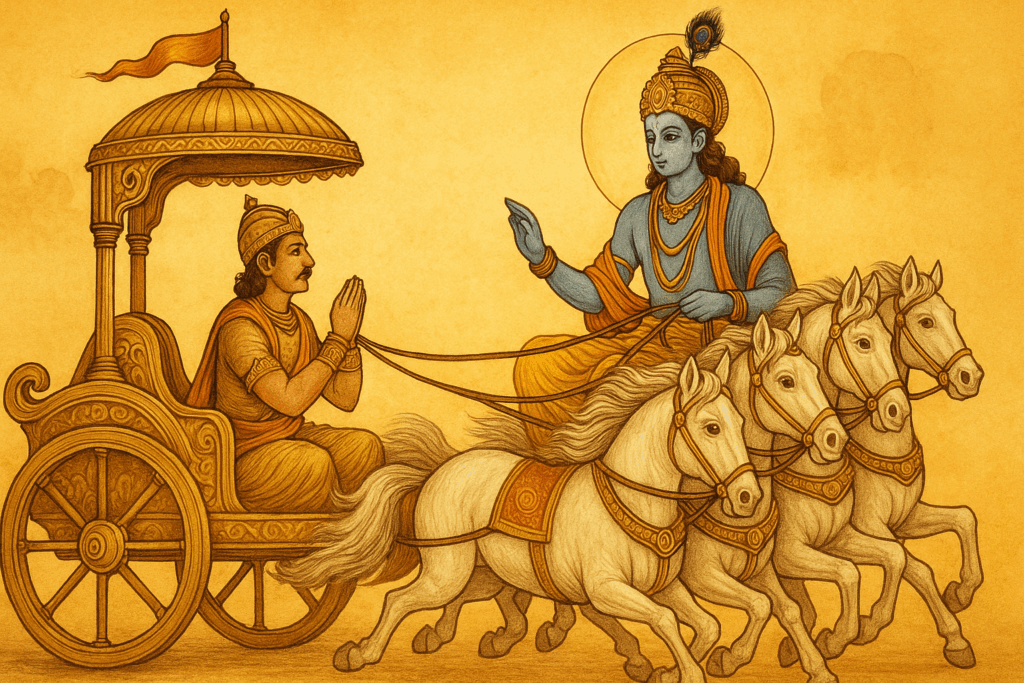
An image that recurs across religions to symbolize the challenges and importance of maintaining and taking mental health seriously is that of the chariot. Driving a chariot beautifully symbolizes mastering the self. Just as charioteers must tame their horses, so too must we tame our minds to be able to forge ahead in life.
The most remarkable book in the Hindu tradition, the Bhagavad Gita, takes place on a chariot, where a prince called Arjuna learns the secrets of mastery over life from his charioteer, Krishna. In this powerful metaphor, the chariot is the human body, the charioteer is intelligence, the five horses are the senses. Only when the senses are reined in, with the help of a disciplined mind, will the chariot carry its owner to his proper destination.
Hinduism
“Know the Self as lord of the chariot, the body as the chariot itself, the discriminating intellect as the charioteer, and the mind as reins. The senses, say the wise, are the horses; selfish desires are the roads they travel.”
— Katha Upanishad (1.3.3-4), Hindu text
Islam
“Picture a charioteer. He is seated in a vehicle, propelled by a horse, guided by himself […] The man, in our illustration, is that which perceives, in a manner superior to the others, the purpose and possibilities of the situation, and who makes it possible for the chariot to move towards and to gain its objective.”
— Sufi parable
Christianity
“The axle of the wheels of the chariot of Providence is Infinite Love, and Gracious Wisdom is the perpetual charioteer.”
— Charles Spurgeon, Christian Baptist preacher
Daoism
“All charioteers must start by learning how to run on the posts. Although it appears that you are training to be agile in your footwork, you are actually training your body to respond to the commands of your mind. This is the key to driving a chariot.”
— Lieh-tzu, Daoist text
Buddhism
“So which do you hit, the cart or the horse? Which do you hit, yourself or your problems? If you start questioning which you should hit, that means you have already started to wander about. But when you actually hit the horse, the cart will go. In truth, the cart and the horse are not different.”
— Shunryu Suzuki, Zen Buddhist monk and teacher