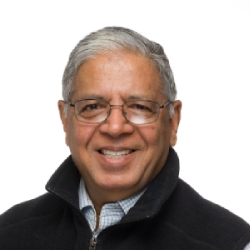

Harvard Divinity School recently caught up with Akhil Gupta, a former fellow at Harvard’s Advanced Leadership Initiative (ALI), a member of the Dean’s Council at HDS, and a member of the advisory board of Harvard’s Human Flourishing Program. In the decade since his time with ALI, Gupta has become a leader in fostering religious literacy and dialogue across difference.
A decade ago, Akhil Gupta joined Harvard’s Advanced Leadership Initiative as a fellow after retiring as chairman of Blackstone India. He thought he would pursue impact investing after Harvard, having learned so much about investing during his time at Blackstone. Instead, he became a student of religion. He is the author of Bridges Across Humanity: Different Religions, Similar Teachings, published in 2023.
Akhil currently serves on the Dean’s Council at Harvard Divinity School, the advisory board of Harvard University’s Human Flourishing Program, and the advisory board of the Harvard T.H. Chan School’s Initiative on Health and Homelessness.
During his time at Harvard, Akhil established a nonprofit foundation, Universal Enlightenment & Flourishing (UEF), which focuses on human flourishing and religious literacy. By highlighting the remarkable commonalities among world religions, he hopes to foster an appreciation of diversity and help create a more peaceful world.
He spoke with the HDS Office of Communications in spring 2025 about his perspective on religion and his time at Harvard.
This interview has been edited for length and clarity.
In 2015, you were a fellow at Harvard’s Advanced Leadership Initiative (ALI). How did that experience change your outlook on religion?
As an ALI fellow, I was allowed to audit classes anywhere at Harvard. After taking Bryan Hehir’s course “Religion and World Politics,” I was surprised by religion’s continued influence on global political and economic affairs—and by the shocking prevalence of religiously fueled violence. I began to question why this behavior so often contradicts the core message of love found across faiths. In my view, the culprit is religious illiteracy.
I went on to take 12 religion classes, and I found many common themes across traditions. I asked myself, why aren’t these commonalities more widely recognized? The answer was that we’ve been asking the wrong question, which is: “Tell me about other religions,” with the subtext being, “Tell me how my religion is superior to the others.”
I approached the study of religion with a different lens, asking instead, “What are the similarities?” Human nature and our deep yearnings are the same, regardless of religious affiliation. All prophets preached moral behavior. So I searched for similarities—and to my amazement, I found 108.
Many courses at Harvard inspired my book. The one that wove everything together was a course at the Graduate School of Education with Robert Kegan. He sees a person’s entire life as a process of meaning-making—but we make meaning with “different orders of mind.” I realized how all religions across millennia address the same fundamental quest for meaning, yet how that quest is filtered through the unique lenses of individual experience: differing contexts, cognitive capacities, educational backgrounds, accumulated knowledge, and developmental orders of mind.
This confluence of factors explains the diversity of religious practice. That’s why the last chapter in my book is about religion and meaning-making. Thinking of religion as a way people make sense of the world allows us to embrace diversity—acknowledging our common quest for meaning, even when our guiding principles differ.
Your organization, UEF, focuses on human flourishing and religious literacy. How did your time at Harvard inspire this project?
I came to Harvard with a background in investing. I was a partner at Acumen, a prestigious impact investing firm, and I thought I would continue in that field after finishing my studies. As I considered how I should give back to society, I was inspired by something columnist David Brooks once said: “People on the road to inner light do not find their vocations by asking, ‘What do I want from life?’ They ask, ‘What is life asking of me?’” So I asked myself: What is life asking of me?
The answer came from then-President Drew Faust’s vision of One Harvard—breaking down silos across the University. That became my mission, too. I could work to dissolve the silos between nationalities, races, cultures, philosophies, and religions. I’ve had the privilege of traversing many diverse cultures and belief systems, thanks to my varied career and open mind. My unique contribution to humanity would be integrating knowledge across continents and centuries—and making these insights accessible to everyone.
How did this project further shape your perspective on religion after being at Harvard?
After my intensive studies, I realized that spirituality is the primal impulse behind many of our actions, and its fundamental aim is to create meaning. This impulse manifests differently across science, philosophy, and religion. Seeing spirituality, religion, science, and philosophy as interconnected was an epiphany for me, born out of my deep dive into Harvard’s intellectual resources. It’s no surprise to me that “spiritual but not religious” is one of the fastest-growing segments in the U.S.
My next book explores the concept of flourishing—which I see as the ultimate outcome of meaning-making. One insight from the 36 classes I took at Harvard is that there are only three fundamental human yearnings: to love, to learn, and to play. These are central to our childhood, when we truly flourish. But we lose touch with them as we grow older. I explore why that happens—and more importantly, how we can reconnect with them—with empathy and care.
You’ve shared ideas and collaborated with a few HDS faculty, including Professor Francis X. Clooney, S.J., who wrote the foreword to Bridges Across Humanity. What is the relationship between Harvard and UEF?
There is no formal relationship, but UEF supports several initiatives at Harvard, including the Human Flourishing Program, the T.H. Chan School’s Initiative on Health and Homelessness, and in recent years, funded several visiting Hindu Monastics at HDS. I also fund an annual lecture on Hinduism organized by the Center for the Study of World Religions (CSWR).
While auditing Professor Clooney’s class, I had lunch with him. He is so humble and exudes a quiet divinity. Over lunch, he told me that HDS had annual lectures on every major religion except Hinduism, due to a lack of funding. So, in 2016, I began supporting that annual lecture.
In Bridges Across Humanity, you emphasize the similarities among religions rather than their differences. How do you see this approach as a path toward peace and understanding?
Since the dawn of religion, society has evolved in countless ways, but the core of human nature has remained the same. Our deeper yearnings transcend faith traditions. Children understand this instinctively. When they play peek-a-boo, they don’t stop to consider someone’s race, beliefs, or background. They simply engage and play. If we can recover that childlike perspective—seeing humanity first, and all other identities second—we can begin to heal some of the deepest divides among us.
My friend, Professor J.V. Singh, once told me: “In the depths of your particularity, you will experience the universalities.” This sentiment is echoed by Professor Clooney, who says he is a better Christian because of his deep understanding of Hinduism alongside his own faith. I firmly believe that tensions among religions stem from religious illiteracy—and Frank is an incredible role model in that regard.
For those who want to learn more about religion, where do you suggest they begin?
Huston Smith’s book on world religions is, in my opinion, the best place to start. The UEF website is also a great resource for exploring the commonalities among faiths. Bridges Across Humanity takes a different approach than most books on religion. Instead of describing each religion as siloed, we present one theme at a time and show how that theme is expressed across traditions. I co-authored the book with HDS alum Allen Simon, MTS ’17, who spent five years researching it.
As we face today’s global challenges, how can we foster dialogue across differences and grow in empathy and compassion?
Two things: First, think for yourself. Don’t blindly accept what others tell you. Learn to be compassionate and listen to those who are different from you. Listen to your inner voice. Listening is loving.
Second, be aware of the false narratives that leaders use to exercise power over us. We must live with heightened awareness in a world filled with misinformation. As Carl Jung said, “Who looks outside, dreams; who looks inside, awakes.”